
Last Updated: October 26, 2026
Quick Summary
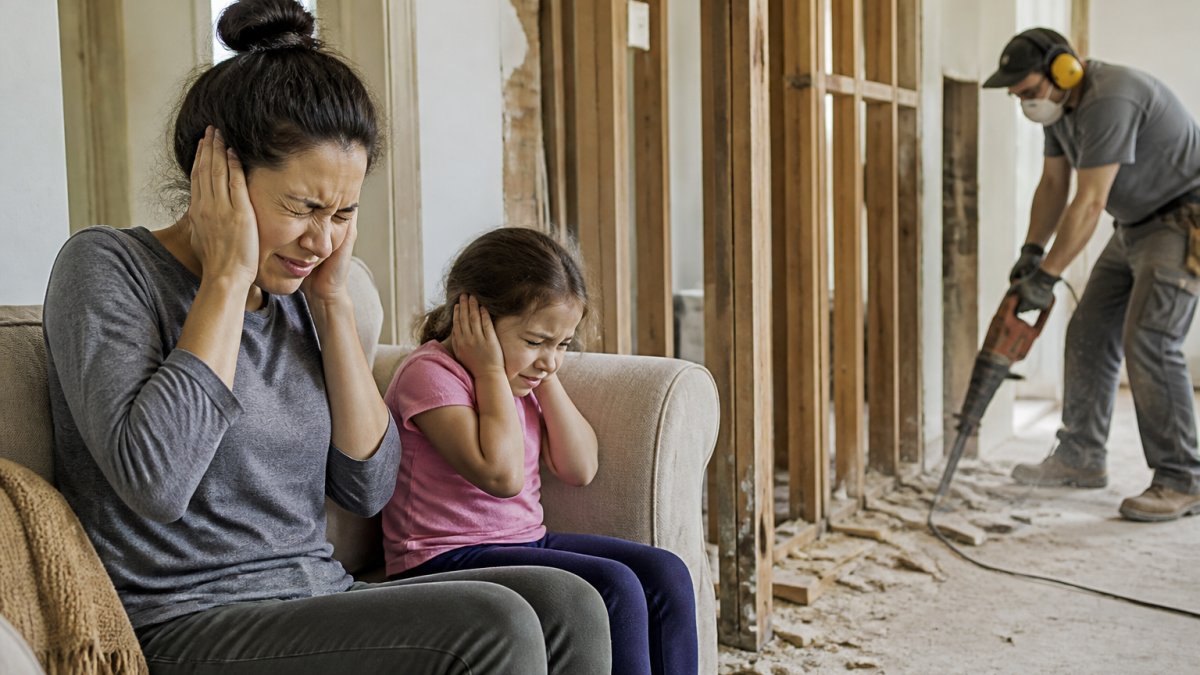
Managing renovation noise with kids at home starts with a written construction noise schedule that maps your child’s naps, bedtimes and meals against the loudest tasks, plus quiet hours agreed in writing. Seal door gaps, hang moving blankets, run a white noise machine and set up a childproofed safe zone far from the work. Give your contractor the quiet windows upfront and ask for a weekly look-ahead of loud tasks.
- Most families choose 12:30 to 2:30 p.m. for naps and after 7 p.m. for bedtime as quiet hours.
- Foam weatherstripping around a quiet room’s door blocks more sound than thick curtains do.
- Place the white noise machine between the child and the door, not next to the crib.
- Post a visual schedule showing loud and quiet days to reduce a sensory-sensitive child’s startle response.
- Ask for at least 24 hours’ notice before any demolition activity.
Table of Contents
- Build a Construction Noise Schedule for Families Before Work Begins
- Set Up Temporary Soundproofing for Home Renovation
- Create a Safe Zone and a Calm-Down Space for Young Children
- Plan Activities for Kids During Home Remodeling
- Talk to Your Contractor About Noise and Safety Constraints
- Protect Sleep, Routines, and Emotional Health During Remodeling
- Prepare for Post-Renovation Recovery With Kids
- Get a Free Project Estimate From KRB Development
- Frequently Asked Questions
Build a Construction Noise Schedule for Families Before Work Begins
Managing renovation noise with kids at home starts before the first hammer swings, and a written plan is the best defense against renovation noise. A construction noise schedule for families is a written plan that maps your child’s day against the loudest tasks, then sets quiet hours everyone agrees to. According to the 2026 U.S. Houzz and Home Renovation Trends Study, 54% of homeowners renovated in 2025.
Map Your Child’s Day Around the Loudest Tasks
Write down nap times, bedtimes, and meal times first. Then ask your contractor which days involve demolition, tile cutting, or framing. Those are the loud ones. Put them on the same calendar.
- Demolition and hammering: schedule for mid-morning
- Tile and saw cutting: group into one block
- Quiet tasks like painting and trim: save for nap windows
Agree on Quiet Hours in Writing
Verbal promises fade by week two. Put quiet hours in the contract or a written addendum. Most families pick 12:30 to 2:30 p.m. for naps and after 7 p.m. for bedtime. Your crew can work around that if they know it upfront.
Set Up Temporary Soundproofing for Home Renovation
Temporary soundproofing for home renovation does not require a remodel of its own. A few cheap moves cut construction noise enough to protect naps and homework. The American Academy of Pediatrics guidance on home renovations advises keeping children away from excessive noise whenever possible.

Understand How Construction Noise Reaches a Child’s Room
Sound travels two ways: through the air (gaps around doors, windows, and outlets) and through the structure (studs, joists, and shared walls). Airborne noise is cheap to block. Structure-borne noise from hammering and sawing is harder because the vibration enters the frame itself. Most practitioners find that sealing gaps first delivers the biggest improvement per dollar, because a half-inch gap under a door can undo an entire wall of insulation.
Low-Cost Fixes That Actually Cut Construction Noise
- Seal the gaps. Foam weatherstripping around the quiet room’s door blocks more sound than thick curtains do. Add a door sweep at the base.
- Add mass to the door. A rolled rug at the base kills the gap echo; a moving blanket hung over the door adds another layer.
- Hang a moving blanket. One heavy blanket over a window cuts street-facing noise. Two layers with an air gap between them work better than one thick layer.
Sensory-Friendly Mitigation for Neurodivergent Children
Most renovation-noise advice treats all kids the same. Children with autism, ADHD, or sensory processing sensitivity often react more severely to construction sound because they cannot filter it out. A few adjustments go beyond standard soundproofing:
- Offer hearing protection, not just masking. Over-ear noise-reduction earmuffs rated for children let a sensory-sensitive child control the input instead of enduring it. Keep them in the safe zone so they are always within reach.
- Create a predictable sound map. Post a simple visual schedule showing which days are loud and which are quiet. Anticipation reduces the startle response more than the noise reduction itself.
- Build a retreat with a closing door. A closet or small room with a solid door and soft surfaces gives a child a place to regulate without leaving the house.
If dust is also a concern, our guide on how to manage dust during home renovation covers containment step by step.
Create a Safe Zone and a Calm-Down Space for Young Children
A safe zone is a childproofed room far from the work area where kids can play, nap, and reset. It needs a door that closes, no exposed outlets, and a clear path to the bathroom.
- Anchor furniture and cover outlet plates
- Store tools and chemicals behind a locked door
- Keep a bin of familiar toys and a favorite blanket inside
- Add a beanbag or floor cushion for meltdown recovery
Sensory overload hits fast in a loud house. A calm-down corner with headphones and a soft seat gives kids a place to decompress without leaving the house.
Plan Activities for Kids During Home Remodeling
Activities for kids during home remodeling need to be portable, quiet, and independent. The goal is to keep small hands busy while crews work. Build a rotation so the same activity does not run dry by 10 a.m. Curating a diverse supply of screen free activities ensures that your children remain engaged and focused even when the construction noise reaches its peak.
| Time Block | Activity | Why It Works |
|---|---|---|
| Morning | Library run or playground | Out of the house during loud work |
| Nap window | Audiobook and quiet room | Masks noise, low effort |
| Afternoon | Craft bin or building blocks | Keeps hands busy indoors |
| Evening | Family walk after crew leaves | Resets the day |
- Rotate toys weekly so they feel new
- Keep a go-bag by the door for quick exits
- Trade playdates with another parent during heavy days
- Use screen time as a tool, not a default
Talk to Your Contractor About Noise and Safety Constraints
Contractor communication is where most renovation stress gets solved or created. Say what you need in the first meeting, not week three. A good builder wants the constraints early because it protects the schedule. Before that conversation, our guide on how to verify general contractor references helps you confirm you hired someone who will listen.
Use a Script That Names the Constraint, Not the Complaint
Vague requests like “please keep it down” get ignored. Name the window, the task, and the fallback. Use this script:
“We have a toddler who naps from 12:30 to 2:30 and a child with noise sensitivity. Can we keep saw cutting and demolition out of that window? Please text me the night before any demolition so we can plan to be out. If a loud task has to move into that window, what is the backup plan?”
Then ask for:
Get a Free Project Estimate – Contact Us Today →
- A weekly look-ahead of loud tasks
- A single point of contact for changes
- Written quiet hours in the schedule
- Advance notice of inspections and deliveries
Put Quiet Hours in Writing
Verbal promises fade by week two. Ask for quiet hours in the contract or a written addendum. A workable clause names the window, the tasks excluded, and the notice required:
“Contractor will avoid demolition, saw cutting, and hammering between 12:30 p.m. and 2:30 p.m. on weekdays. Contractor will provide at least 24 hours’ notice before any demolition activity. If a schedule change requires loud work during the quiet window, Contractor will notify Owner by text the prior evening and reschedule where feasible.”
Most families pick 12:30 to 2:30 p.m. for naps and after 7 p.m. for bedtime. Your crew can work around that if they know it upfront.
Set Safety Rules for the Work Zone
Noise and safety travel together. Ask the crew to keep the work zone behind a closed door or plastic barrier, to store tools and chemicals out of reach at the end of each day, and to sweep nails and screws before leaving. Confirm who is responsible for locking the work area overnight and how deliveries are staged so children are not near the drop zone.
Escalate Early, Not Angrily
If quiet hours slip, raise it the same week with the project lead, not at the final walkthrough. A short text, “Saw cutting happened at 1 p.m. today; can we reset the quiet window for tomorrow?”, keeps the issue factual and easy to fix.
KRB Development assigns one hands-on lead to each project, so families get the same person from walkthrough to final walk, not a rotating cast.
Protect Sleep, Routines, and Emotional Health During Remodeling
Sleep regression and routine disruption are the real costs of a loud house. Kids act out when their day loses shape. Keep bedtime, meals, and nap times fixed even when everything else moves.
- Hold the bedtime routine exactly as before
- Use the white noise machine every night, not just loud days
- Warn kids the night before a noisy task
- Name the feelings: “The house is loud today, and that is okay”
Researchers at the University of Maryland College of Education have studied whether a noisy home helps or hurts young children’s speech. The takeaway for parents is simple: reduce the noise where you can, and give kids quiet space to talk and listen.
Prepare for Post-Renovation Recovery With Kids
The last week of a remodel is not the finish line for kids. Post-renovation recovery means resetting routines, cleaning thoroughly, and letting children reclaim the space. Plan a soft landing.
- Do a deep clean before kids return to the new rooms
- Check air quality by airing out rooms for a few days
- Re-childproof the new space, including new cabinets and outlets
- Let kids help pick one item for their room
If your home was built before 1978, the EPA’s Renovation, Repair and Painting Rule requires certified lead-safe work practices on painted surfaces. Ask your contractor how they handle it before work begins.
Get a Free Project Estimate From KRB Development
A loud renovation does not have to upend your family’s year. The right plan, the right quiet hours, and the right crew make the difference. KRB Development has served homeowners since 2005 with hands-on leadership, on-time and on-budget delivery, and a real focus on the details that keep families comfortable. We build noise and safety planning into every custom renovation from day one.
Frequently Asked Questions
How can I soundproof a room temporarily during home renovations?
Start with the gaps. Seal the door with a draft stopper or a rolled towel, close windows, and hang a heavy moving blanket over the doorway. A thick rug and soft furnishings absorb some of the construction noise. A white noise machine near the crib or bed masks the rest. These are temporary measures, so plan to remove them once the work ends. Ask your contractor which walls will see the loudest work so you can prioritize those rooms.
How do I maintain a nap schedule when contractors are working?
Build a construction noise schedule for families before work starts. Ask your contractor which days involve demolition, drilling, or heavy equipment, then plan naps and quiet time around those blocks. Set up a sleep space in the quietest room, away from the work zone, and use a white noise machine to cover intermittent sounds. If a loud task lands at nap time, ask whether it can shift by an hour. Most crews can adjust the order of work when asked early.
What are the best ways to keep kids entertained during noisy construction hours?
Get out of the house for the loudest parts of the day. Plan activities for kids during home remodeling that do not depend on quiet, such as a park visit, library story time, or a playdate. At home, set up a calm corner with books, puzzles, and headphones. Keep a bag packed with snacks and supplies so you can leave quickly when drilling starts. A predictable daily plan reduces stress for both you and your children.
How can I communicate effectively with my contractor about noise-sensitive times?
Put your constraints in writing before work begins. List nap times, bedtime, work-from-home calls, and any sensory needs in a short email or shared document. Ask your contractor to confirm which tasks are loudest and when they are scheduled. Agree on quiet hours and a daily check-in. A written record prevents misunderstandings and gives the crew a clear plan. KRB Development builds these details into the project schedule from the start.
